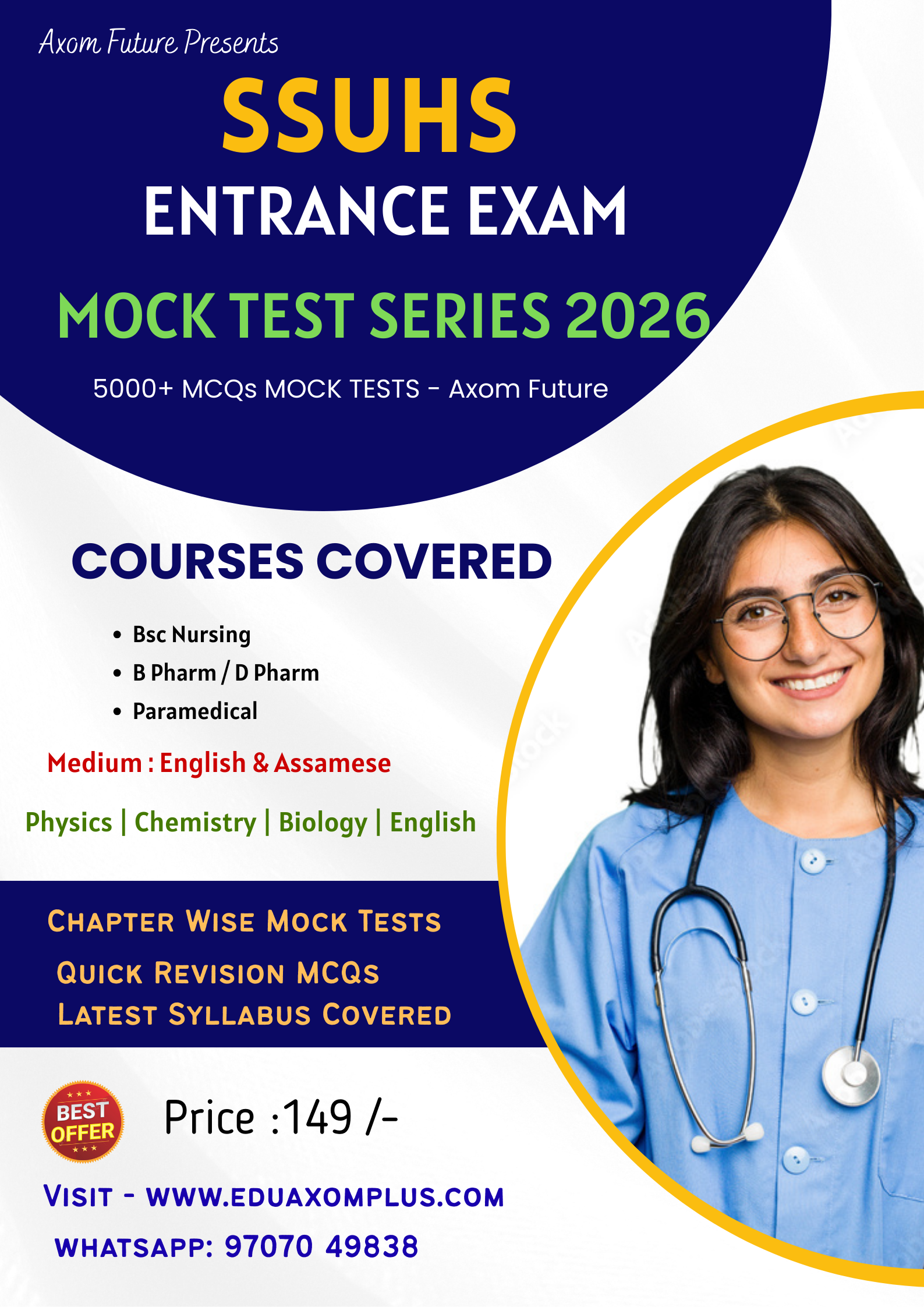
NEET 2026 Syllabus: The National Eligibility cum Entrance Test (NEET) UG 2026 is a crucial exam for aspiring medical students in India. Conducted by the National Testing Agency (NTA), it follows the syllabus finalized by the Under Graduate Medical Education Board (UGMEB) of the National Medical Commission (NMC). This updated syllabus, released via public notices in December 2025 and January 2026, ensures alignment with modern medical education standards. It covers Physics, Chemistry, and Biology, emphasizing conceptual understanding, practical skills, and application-based learning. Candidates are advised to refer to this syllabus for targeted preparation, as the exam will strictly adhere to it. For official details, visit NMC’s website or NTA NEET portal.
In this comprehensive guide, we break down the NEET 2026 syllabus subject-wise, including key units, topics, and practical experiments. This post is designed to help students from Assam and across India plan their studies effectively. Stay updated with EduAxomPlus for more NEET tips, mock tests, and resources.
NEET 2026 Key Highlights
| Aspect | Details |
|---|---|
| Conducting Body | National Testing Agency (NTA) |
| Official Website | https://neet.nta.nic.in/ |
| Purpose | Admission to MBBS, BDS, BVSc & AH, B.Sc. Nursing, AYUSH courses (BAMS, BUMS, BSMS, BHMS) across India |
| Exam Mode | Pen-and-Paper (OMR-based) |
| Languages | 13 (including English, Hindi, Assamese, Bengali, and others) |
| Exam Duration | 3 hours (180 minutes) |
| Total Marks | 720 |
| Notification Release | February 8, 2026 |
NEET 2026 Physics Syllabus
Physics in NEET 2026 tests fundamental principles and their applications. The syllabus is divided into 20 units, covering mechanics, thermodynamics, electricity, and modern physics. Below is a detailed breakdown:
Physics Units and Topics
| Unit | Title | Key Topics |
|---|---|---|
| 1 | Physics and Measurement | Units of measurements, SI units, errors in measurements, dimensional analysis. |
| 2 | Kinematics | Motion in straight line and plane, vectors, projectile motion, uniform circular motion. |
| 3 | Laws of Motion | Newton’s laws, conservation of momentum, friction, centripetal force. |
| 4 | Work, Energy, and Power | Work-energy theorem, conservation of energy, collisions. |
| 5 | Rotational Motion | Centre of mass, moment of inertia, torque, angular momentum. |
| 6 | Gravitation | Universal law, gravitational potential, satellite motion. |
| 7 | Properties of Solids and Liquids | Elasticity, fluid pressure, viscosity, surface tension, thermal expansion. |
| 8 | Thermodynamics | Laws of thermodynamics, isothermal and adiabatic processes. |
| 9 | Kinetic Theory of Gases | Ideal gas equation, kinetic interpretation of temperature. |
| 10 | Oscillations and Waves | Simple harmonic motion, wave motion, standing waves. |
| 11 | Electrostatics | Coulomb’s law, electric field, Gauss’s law, capacitors. |
| 12 | Current Electricity | Ohm’s law, Kirchhoff’s laws, Wheatstone bridge. |
| 13 | Magnetic Effects of Current and Magnetism | Biot-Savart law, Ampere’s law, magnetic materials. |
| 14 | Electromagnetic Induction and Alternating Currents | Faraday’s law, LCR circuits, AC generator. |
| 15 | Electromagnetic Waves | Characteristics, electromagnetic spectrum. |
| 16 | Optics | Reflection, refraction, lenses, wave optics, polarization. |
| 17 | Dual Nature of Matter and Radiation | Photoelectric effect, de Broglie relation. |
| 18 | Atoms and Nuclei | Bohr model, nuclear fission and fusion. |
| 19 | Electronic Devices | Semiconductors, diodes, logic gates. |
| 20 | Experimental Skills | Vernier calipers, screw gauge, simple pendulum, and 15+ practical experiments. |
Focus on numerical problems and derivations for high scores. Practical skills include experiments like finding focal length of lenses and resistivity using metre bridge.
NEET 2026 Chemistry Syllabus
Chemistry is split into Physical, Inorganic, and Organic sections, with 20 units total. It emphasizes conceptual clarity, reactions, and quantitative analysis.
Physical Chemistry Units
| Unit | Title | Key Topics |
|---|---|---|
| 1 | Some Basic Concepts in Chemistry | Matter, laws of chemical combination, stoichiometry. |
| 2 | Atomic Structure | Bohr model, quantum numbers, electronic configuration. |
| 3 | Chemical Bonding and Molecular Structure | Ionic and covalent bonds, VSEPR theory, molecular orbital theory. |
| 4 | Chemical Thermodynamics | Laws of thermodynamics, enthalpy, Gibbs energy. |
| 5 | Solutions | Concentration methods, colligative properties, van’t Hoff factor. |
| 6 | Equilibrium | Chemical and ionic equilibrium, Le Chatelier’s principle, pH. |
| 7 | Redox Reactions and Electrochemistry | Oxidation numbers, Nernst equation, electrochemical cells. |
| 8 | Chemical Kinetics | Rate laws, activation energy, Arrhenius theory. |
Inorganic Chemistry Units
| Unit | Title | Key Topics |
|---|---|---|
| 9 | Classification of Elements and Periodicity in Properties | Periodic trends, s/p/d/f blocks. |
| 10 | p-Block Elements | Groups 13-18: Trends, unique behaviors. |
| 11 | d- and f-Block Elements | Transition elements, lanthanoids, actinoids. |
| 12 | Coordination Compounds | Werner’s theory, isomerism, crystal field theory. |

Organic Chemistry Units
| Unit | Title | Key Topics |
|---|---|---|
| 13 | Purification and Characterisation of Organic Compounds | Purification methods, qualitative/quantitative analysis. |
| 14 | Some Basic Principles of Organic Chemistry | Nomenclature, isomerism, reaction mechanisms. |
| 15 | Hydrocarbons | Alkanes, alkenes, alkynes, aromatic hydrocarbons. |
| 16 | Organic Compounds Containing Halogens | Preparation, reactions, environmental effects. |
| 17 | Organic Compounds Containing Oxygen | Alcohols, phenols, ethers, aldehydes, ketones, carboxylic acids. |
| 18 | Organic Compounds Containing Nitrogen | Amines, diazonium salts. |
| 19 | Biomolecules | Carbohydrates, proteins, vitamins, nucleic acids. |
| 20 | Principles Related to Practical Chemistry | Detection of elements, titrations, salt analysis, and 4 experiments. |
Practice reaction mechanisms and numericals in physical chemistry for better performance.
NEET 2026 Biology Syllabus
Biology carries the highest weightage, with 10 units focusing on diversity, physiology, genetics, and ecology.
Biology Units and Topics
| Unit | Title | Key Topics |
|---|---|---|
| 1 | Diversity in Living World | Classification, five kingdoms, taxonomy. |
| 2 | Structural Organisation in Animals and Plants | Tissues, morphology, anatomy of plants and animals. |
| 3 | Cell Structure and Function | Cell theory, organelles, biomolecules, cell division. |
| 4 | Plant Physiology | Photosynthesis, respiration, growth regulators. |
| 5 | Human Physiology | Breathing, circulation, excretion, locomotion, neural control, hormones. |
| 6 | Reproduction | Flowering plants, human reproduction, reproductive health. |
| 7 | Genetics and Evolution | Mendelian inheritance, molecular basis, evolution theories. |
| 8 | Biology and Human Welfare | Diseases, immunology, microbes in welfare. |
| 9 | Biotechnology and Its Applications | Genetic engineering, applications in health and agriculture. |
| 10 | Ecology and Environment | Ecosystems, biodiversity, conservation. |
Diagrams and processes like photosynthesis and human reproduction are key. Practical aspects include morphology and physiology experiments.
Preparation Tips for NEET 2026
- Study Plan: Allocate time equally to all subjects, focusing on weak areas.
- Resources: Use NCERT books as the base, supplemented by reference materials.
- Practice: Solve previous years’ papers and mock tests.
- Stay Updated: Follow NTA and NMC for any further announcements.
- For Assam students: Join local coaching or online forums for region-specific guidance.
Quick Links of NEET UG 2026 Application Form
| Official Notification | Click Here |
| Application Form | Click Here |
| Official Website | Click Here |
| Syllabus 2026 | Click Here |
| Subscribe Us | Click here |
| Follow Us (Instagram) | Follow |
| WhatsApp Channel | Join Now |
| Facebook Page | Click here |
| Home Page | Click Here |